

I started this trip report on a plane from Lima heading to the famous Cusco region, known throughout the world as the home of Machu Picchu and the heart of the ancient Inca civilisation. I didn’t actually come to Peru to see this wonder, I came to experience how coffee is produced and witness first hand the (seeming) explosion in Peru speciality coffee. This leg is actually the final part of a 10 day trip with Mark from Khipu coffee, a UK based importer of Peruvian specialty coffee, with the first week spent up in the Cajamarca and Amazonas regions.
I’ve mentioned this in socials and also coffee descriptors on the web site over the last year or so, that in the past I (and probably many others) have underrated and undervalued Peru speciality coffee. Yeh, sure they produce a huge amount of commercial grade coffees and have good solid all day everyday sweet and clean washed coffees from the north. I remember having a San Ignacio coffee back when Crankhouse was first beginning on this journey. Nice coffees. Nice.
But now my opinion is vastly different. Last year my favourite coffee we had on the list was a washed Geisha from Amazonas in Peru, as well as another 2 or 3 that would easily fit in the top 10 of the best coffees we had last year (and into this year). Two producers in particular from Lonya Grande were Marcos Herrera from Finca Mamaruntu and Roiber Bacerra from Finca Morales. An anaerobic natural Geisha and Red Bourbon from Marcos and an anaerobic natural Geisha from Roiber. Absolutely stunning coffees.
Mark started Khipu about 5 years ago and has slowly been building a network of great producers he works with across a few regions. Last year he ran his first origin trip with customers and I immediately knew it was going on the wish list of trips for this year. The itinerary included visiting Marcos and Roiber as well as some other top producers across Cajamarca, Amazonas and Cusco. Having the opportunity to meet the people that produce the coffees we’ve bought from previously is always a highlight and for me adds even more meaning to the way I’ve been buying coffees over the past 13 years since starting the business. A lot has changed since those early days of buying a bag or two off a spot/offer list (a shopping list of coffees already landed and in stock in the UK). These days the buying process is much closer to ‘relationship’ buying, where I’ve met directly or have a connection with the producer directly or least via the exporter/importer.
Before the trip started proper and whilst we waited for others to arrive, we popped over to see a producer friend of Mark’s. Kevin Román runs the AYNI Association which has 14 members in the Huyro region in Cusco and happened to have some fresh crop coffees from a number of the association members roasted and ready to cup. I felt quite privileged to be tasting these fresh coffees before anyone else had tasted them. What a way to start the trip.

My fellow coffee travellers were Sam from big-guns Watchouse Coffee, Karl (and his partner Ali) from Ancoats coffee with a brief connection for the later Cusco part with Siala from Elsewhere and Travas (from Modcup Coffee in the US and his partner Maritza on their honeymoon). One of the smaller trips I’ve been on in terms of numbers of people but definitely not in terms of the distances traveled. I honestly wasn’t prepared mentally for the amount of driving that was necessary to get into these remote coffee growing regions that I’d heard of and seen on a map. Seven to eight hour days in the car were typical along dirt and gravel mountain tracks. Our first 7 hr dirt adventure was from the tiny airport at Chiclayo to Jaen, the heart of coffee in the north of Peru. Until recently Jaen had an operational airport but apparently the runway was in such poor condition that the national airline LATAM had decided they could no longer safely land at that airport. I’m convinced that all the coffee businesses (big and small) around the globe could petition the Peruvian government to repair and reinstate Jaen’s airport for the benefit of everyone.

Our first producer meeting and cupping was at the Finca El Morito mill in Jaen which we started at 8.59pm ! This was a sign of days to come. What made up for the long day was the quality of coffees on the table. Two stood out for me, from mother and son duo Maria and Anton, one a washed Caturra, the other a washed Marshel (which I’d not heard of before). These were alongside a table of washed and natural and washed Bourbons and our first cupping as a group allowed us to get a sense of how close or far away we were from each other in the way we approached assessing coffees. A quick late dinner and bed by midnight. Day 1 done.

Day 2 started by visiting well known producer Ebert Huamán Villegas at his warehouse in Jaen, where we were treated to a few brews of a couple of their fresh crop coffees as well as something I’d taken with me from Rwanda (typically producers don’t get to taste much coffee from other origins). Then we all jumped in the 4WDs and off we went to Ebert’s farm Finca Artimira way up near the Ecuadorean border in the town of Salinas in San Jose de Lourdes (another 7-8 hrs that day).. Bonkers steep and barely navigable in our vehicles let alone a truck loaded with coffee.


Once there we were ‘treated’ to a farm tour. I’ve experienced the steep slopes typical in Colombia, Costa Rica and Guatemala but this was different. The recent rains had made the slopes incredibly muddy and slippery, combined with extremely dense layout of coffee trees it felt like taking a leap into the unknown at times. Our expedition leader was Ebert’s younger brother Johnny, who was dressed in casual clothing and deck shoes. He seemed to be navigating the steep slippery slopes without any difficulty at all. We all lived to tell the tale.

The hour was getting late which of course meant it was cupping time. During the tour Ebert had shown us a number of different plots with different looking Geisha trees. He mentioned he had 5 different Geisha varieties with different traits and different cup characteristics, some more floral, some more fruit forward. All from different seeds he’d obtained through various sources. Alongside these 5 types of Geisha the table had two Pink Bourbons, a Sidra, Tabi, Caturra and a Catuai. This was a special table of goodies, with a couple of absolutely stunning coffees. I think we finished cupping at 11pm and then it was BBQ time with an endless supply of marinated chicken and beef and plantains. What an incredible way to finish off Day 2.

A super early start, partly caused by the most amazing dawn chorus kicked off by the local Donkeys, who were immediately joined by dogs, chickens and birds. All that at 5.00am on the dot. Before leaving for the next stage of our adventure we sat down to a very welcome and hearty spiced chicken soup before the long journey back to Jaen. Our final destination for the day was Lonya Grande but the only way to get there was to go back via Jaen. Before visiting the farm we stopped off on the way to see Franklin at Finca La Familia’s QC lab in San Ignacio and tasted some of Franklin’s coffees before taking a surprise visit to Simon’s place @chacracoffee. I met Simon back in 2013 at a cupping he was hosting for Falcon Coffee. He then headed up the build out of the Falcon warehouse operation in Jaen. Met someone, bought a farm, planted seeds, started an export operation and now imports his own coffees (Las Etiopes) into the UK as well as from producers he works with. That clearly wasn’t enough so he also opened a high end coffee shop and pasta bar. The pasta was freshly made in front of us and a simple but very tasty dish appeared on all our plates. Unfortunately Simon was out on the school run so I didn’t get to reconnect in person but the moment felt quite special regardless.

On we went to Lonya Grande and another late night cupping with a full table of 18 coffees, and four producers ready and waiting for us. Two I’ve mentioned previously, Marcos Herrera and Roiber Beccera, alongside Winkler Tapia from Finca Orquedias and Manuel Marla Baca from Finca Pacpa. WOW - what a table of stunners. Geisha’s, Bourbon’s, and a beautiful Pacamara. Something new for me was tasting the same variety from the same farm but on ‘young’ trees versus ‘older’ trees (only 2 years growth between them). There was a clear difference, with the more mature trees having a more rounded balanced profile. We were joined for a late night snack by these four producers and once again it felt fuelling to be in the presence of these extremely humble hard working people.

On the agenda for the next day was to visit three of the four producers at their farms. Roiber’s Finca Morales for breakfast, Winkler’s Finca Orquedias for lunch and Manuel’s Finca Pacpa for a snack. Once again we were all blown away by the hospitality we received by the producers and their families. Three very different farms in size, layout and management. One special mention goes out to Zeus, Roiber’s ‘guard’ dog. A nine month old Doberman and without question the most handsome farm dog I’ve ever seen. When he grows up he’ll be expected to guard the farm, the purpose for which he was bought. They’ve had multiple thefts over the years of their valuable coffee trees and harvested cherries, and have installed numerous motion sensor cameras around the property to protect their livelihoods. The other special mention goes to Manuel's Pacamara trees, some of which must have been easily over 6m tall. Three special farm visits with these top tier producers, perfect preparation for another 5 hrs in the vehicles, destination Chachapoyas. This marked the end of the ‘northern’ Peru part of the trip, with the next stage in the famous Cusco region ahead for some of us via transfers to Lima.


The highest altitude I’ve ever been at before this trip was at the viewing platform on Mont Blanc at 3840m and after a few minutes I felt dizzy, nauseous and very weak. Cusco sits at 3400m and I’d been warned that altitude sickness here was a real thing. The short walk from the tiny plane to the terminal building felt difficult. Walking and talking was almost impossible and that light headedness and mild nausea came on immediately. Luckily a herbal mint like tea (Muña) was widely available and helped soothed those symptoms. Our first coffee event was at a tiny coffee shop called Kusama, hidden at the back of a mall of shops, to meet producer Synthia Castellanos. Some of you might remember that name from a couple of years ago. We had two lovely coffees from Synthia and her farm Finca Tunkimaya (through another importer Evie at Que Onda), and it was an unexpected treat to meet Synthia on this trip. The shop owner Nicolai brewed up a number of Synthia’s coffees for us and you could easily see that this was someone who was into the detail of brewing. The coffees tasted great and Nicolai explained that brewing at this altitude needed to be handled differently. First, water boils at a much lower temp (87-88C) and therefore extraction needs to be increased with much finer grinds than we’d be used to for filter brewing at sea level. But to get finer grinds without losing aromatics, Nicolai used a slow rpm setting on his high end filter specific grinder, in combination with very high flow rate filter papers and a pouring technique that exacerbated agitation ! WOW. This was a masterclass in brewing that continued for another 30mins or so with a masterclass in espresso puck preparation. Nicolai came 2nd in the Peru national barista championships this year. Another special moment.

My final ‘coffee’ day began at another high end speciality coffee shop Latente. The owner Steven had joined us the previous evening at Kusama and his shop was sleek and very stylish with Peru’s current Aeropress champion behind the counter. Of course, we ordered an Aeropress brew of an SL9 (the latest and greatest variety discovered in the Cusco region), and it was super super light and fruity, but without any of the astringency and dryness I normally associate with very light roasts. Then back in our new 4WDs and off for our 5hr adventure across to the Huayopata growing region over the 4330m Abra Malaga pass. If the clouds had cleared I’m sure the scenery would have been spectacular. On arrival at our first destination, we were met by Kevin from AYNI (we were now on Kevin’s turf) and he introduced us to producer Luisa Zamalloa and off we went to tour her farm. Incredibly healthy trees and everything felt alive. Rich healthy soil and the recent rains had caused a flowering on the coffee trees which had underripe, ripe and now flowers on the same branches. In the middle of the harvest this is not an ideal situation, since the cherries remaining on the trees require energy to ripen. The tree has already put it’s resources into those fruits and now with the new flowers it will divert it’s energies into those for reproduction (Arabica is self pollinating but strength and resilience is gained by cross pollinating). This is not a new phenomenon in coffee but a gradual consequence of climate change that has ripped up the ‘old’ rule book with specific harvest periods and predictable weather patterns. Luisa and Kevin brewed us up some of her washed Geisha. Kevin had V60 and scales and Louisa with a traditional Gota Gota, just a scoop of coffee and water. No scales, no precision brewer. There was no question which tasted better.. Louisa’s won hands down.

Then onto Louisa’s cousin’s farm.. a delicious lunch came first and then Fidel picked a couple of lettuces and carrots and proceeded to tell us about soil composition, nutrients, bugs, smoke and the optimum productivity range of plants versus humans. It felt like a biodynamic, regenerative agriculture educational lecture… soon to be followed by tour. I think we must have seen at least 8 different Geisha tree varieties, some from seeds from Panama, some elsewhere and some hybrids all carefully managed and cared for with organic ‘poo’ compost, and natural additives such as boron, molybdenum, magnesium and much more. Fidel’s energy and passion pervaded everything and a clear example of someone that was working with nature. His drying beds were almost empty which I assumed was because his coffees had already been dried and were resting (reposo) or already at the warehouse. When Fidel explained that this small amount of coffee was his entire harvest I was stunned. Clearly not enough to make a living from.
My final cupping of the trip was another late night do at the newly constructed AYNI Association HQ built alongside association founder Jessica’s house. Another table of delicious coffees from local producers which we cupped blind. There was one absolute standout on the table which everyone huddled around and it was no surprise that it turned out to be from Señor Fidel. I knew that a man that cared so much about his carrots and lettuces had to have great coffee.

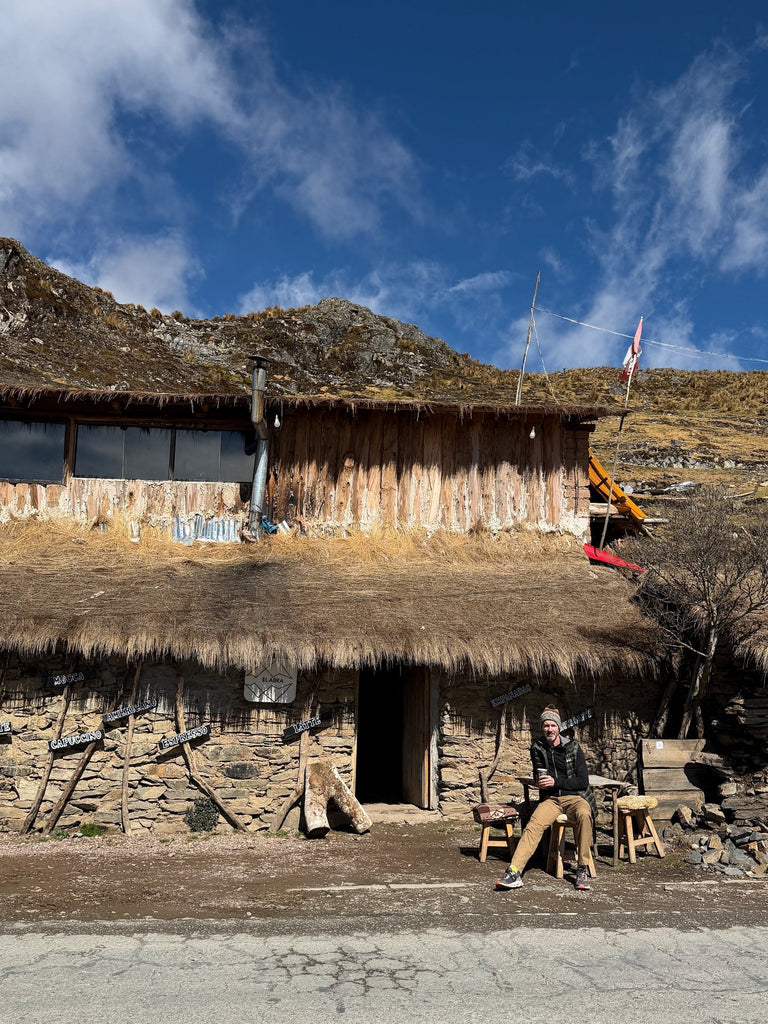
One final 7hr drive in the car back over the Abra Malaga pass to Cusco and this time the sky was blue and the scenery was absolutely stunning with the 5900m Nevado Veronica hovering over us for a good majority of the journey. This time over the pass we stopped at probably one of the world’s highest speciality coffee shops at 4330m. Sitting in the sunshine with a brew and sharing an almond croissant with my new friend and fellow return traveller Steven from Latente felt pretty special.

I’ve come away from this trip with a much better appreciation of Peru as a serious player in the speciality coffee market place. The coffees we tasted were very high quality across the board with an abundance of good Geishas and Bourbons as well as Caturras and SL09s (the few I tasted). I’ve made tentative commitments to a number of coffees with Mark from the different regions and producers we visited. It’s easy to get carried away on a trip like this and there’s always something different to see, something new to learn, friendly and humble producers, other fabulous coffee folk to share the experience with and of course delicious coffee.
If you've made it this far you might be wondering what the title of this trip report means. My first origin trip was in 2016, so this is the tenth year of traveling to meet producers and get a closer glimpse of how they live and an insight into the care and attention they pay to growing and processing the coffee we take ownership of for a short period and share with our customers. This trip was also my tenth origin country I've visited which is quite something. Also, at the time of writing I've already highlighted nine different microlots from the trip. Only one more to add to make the story complete.
Muchas gracias Mark y muchas gracias Peru.

2 Comment
Phil on
Thank you Dave, for another characteristically evocative travelogue. I love reading about your visits as much as you obviously enjoy making them – and I benefit from not having to endure 7+ hours on the 4 WD equivalent of cyclocross.
You also confirm my experience as a consumer (of your coffee and other roasters in whatever coffee shop I find myself) that the quality of Peruvian coffee has improved incredibly over the last couple of years in particular.
And I wonder where your 11th trip to origin will be?
Thank you as always for bringing coffee alive,
Phil
Phil on
Thank you Dave, for another characteristically evocative travelogue. I love reading about your visits as much as you obviously enjoy making them – and I benefit from not having to endure 7+ hours on the 4 WD equivalent of cyclocross.
You also confirm my experience as a consumer (of your coffee and other roasters in whatever coffee shop I find myself) that the quality of Peruvian coffee has improved incredibly over the last couple of years in particular.
And I wonder where your 11th trip to origin will be?
Thank you as always for bringing coffee alive,
Phil